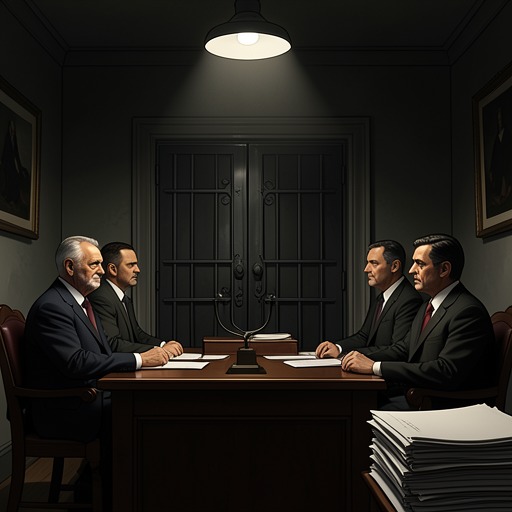
Payton Reisky
The RainmakerPayton Reisky appears in the Black family’s trial as an experienced insurance-industry expert called by Great Benefit to defend its handling of Donny Ray Black’s claim. He presents the denial as reasonable under a modest policy and describes the company’s practices as broadly consistent with industry standards. On cross-examination, however, Rudy Baylor redirects attention from technical procedures to Reisky’s institutional ties and the human consequences of the claim. Reisky’s testimony ends in a brief, revealing rupture: when he affirms that Great Benefit treated the claim fairly, jurors laugh.
Identity and Professional Position
Reisky is introduced as the Executive Director and President of the National Insurance Alliance, a Washington-based political organization whose funding comes from insurance companies. The organization presents itself as promoting fair insurance practices and lobbying on insurance matters. Reisky has spent thirty years in the business, and Leo F. Drummond establishes his professional credentials before asking that he be qualified as an expert in insurance claims practice and procedure. Rudy Baylor does not object. He has studied Reisky’s testimony from another trial and believes he can manage the witness, while recognizing that an expert would have to be exceptionally gifted to make Great Benefit’s Section U procedures appear defensible.
Reisky’s position gives him a dual function in the courtroom. He speaks as a specialist in claims handling, but he also represents an organization financed by the industry whose conduct is at issue. Drummond’s presentation emphasizes the first role; Baylor’s questioning later makes the second impossible to overlook.
Defense Testimony
Drummond gives Reisky room to explain how a claim should be processed. Reisky sets out a checklist of proper procedures, and Drummond’s manner suggests that the account will establish that Great Benefit followed the rules. Reisky’s conclusion is that the company had the right to deny the claim, especially given its size. He contrasts a policy costing eighteen dollars a week with a bone marrow transplant costing two hundred thousand dollars, arguing that a debit policy provides basic coverage rather than every possible benefit.
The missing portions of the company manuals also enter his account. Reisky characterizes the absence of sections as unfortunate but not decisive: manuals are continually modified and, in his view, experienced claims handlers may rely on their own knowledge instead. He takes the claims manual and leads the jury through its printed procedures, presenting the process as orderly and workable. His testimony thus offers an explanation for both the denial and the manual irregularities, while treating those irregularities as less important than the company’s general practices.
Drummond also asks Reisky to interpret Great Benefit’s claims figures. Reisky acknowledges that the company recorded a high denial rate in 1991, but says that such a rate could have explanations and cautions against relying too heavily on the numbers. Looking across the preceding ten years, he gives the company’s average denial rate as slightly below twelve percent, which he describes as within the industry average. He uses a multicolored chart to walk the jury through the statistics, speaking in the manner of a practiced lecturer. The account supplies a broader comparison that could make the disputed year seem less exceptional, even as the unusually high 1991 denials remain part of the evidence.
Cross-Examination and Institutional Ties
The next morning, Baylor begins by showing Reisky The Stupid Letter and asking for his professional assessment. Reisky calls it a horrible and unfair response. He adds that the letter’s author, Krokit, is no longer with Great Benefit, but cannot identify who told him this or explain why Krokit left. Baylor establishes that Krokit departed two days before he was due to give a deposition in the case. Reisky does not know whether the departure was related to the letter, and Baylor makes clear that the witness cannot support an implication about its cause. The exchange exposes the limits of Reisky’s knowledge without establishing a reason for Krokit’s departure.
Baylor chooses not to spend the day confronting Reisky with the manuals and statistics. Those materials have already been presented, the jury has heard earlier testimony about the manuals, and Reisky has had time to prepare. Instead, Baylor asks who funds the National Insurance Alliance and whether Great Benefit contributes. Reisky confirms that the company contributes ten thousand dollars a year. He further states that the Alliance has no funding outside the insurance industry, that two hundred and twenty insurers contribute, and that their total contributions in the previous year were six million dollars. The Alliance does some lobbying. Reisky says he receives no extra payment for testifying and that Great Benefit contacted him and asked him to appear.
Baylor then asks Reisky to look directly at Dot Black and say whether her son’s claim was handled fairly and properly. Reisky pauses to focus on her, then answers that it was. The question brings the dispute out of the language of policy costs, procedures, and industry averages and places the testimony before the bereaved mother whose family’s claim is on trial.
Courtroom Reception and Narrative Role
A juror laughs at Reisky’s answer, then quickly tries to contain the reaction. Laughter spreads through the jury box; some jurors look at him in disbelief, while others shake their heads. Reisky lowers his head and studies the floor, appearing to take the laughter as a judgment on his testimony. Drummond’s team turns to its files, and Judge Kipler allows the moment to run briefly before rapping his gavel as the laughter subsides. The episode lasts only seconds, but Baylor reads it as a release of the jurors’ disbelief and as a sharp contrast to the authority Reisky’s credentials and chart had lent his defense.
Baylor ends the cross-examination rather than continuing through the manuals and figures. That restraint prevents Reisky from returning to a long technical defense and makes the direct question to Dot the witness’s final defining moment. The trial narrative does not establish that Reisky personally designed Great Benefit’s procedures or knew the full history behind the denial. It does show how his expert presentation seeks to normalize the company’s actions, while his Alliance’s funding and his uncertain knowledge of the letter complicate his independence. His testimony becomes a contest between institutional explanation and the specific claim denied to Donny Ray Black; the jurors’ laughter marks the point where the explanation no longer controls the room.